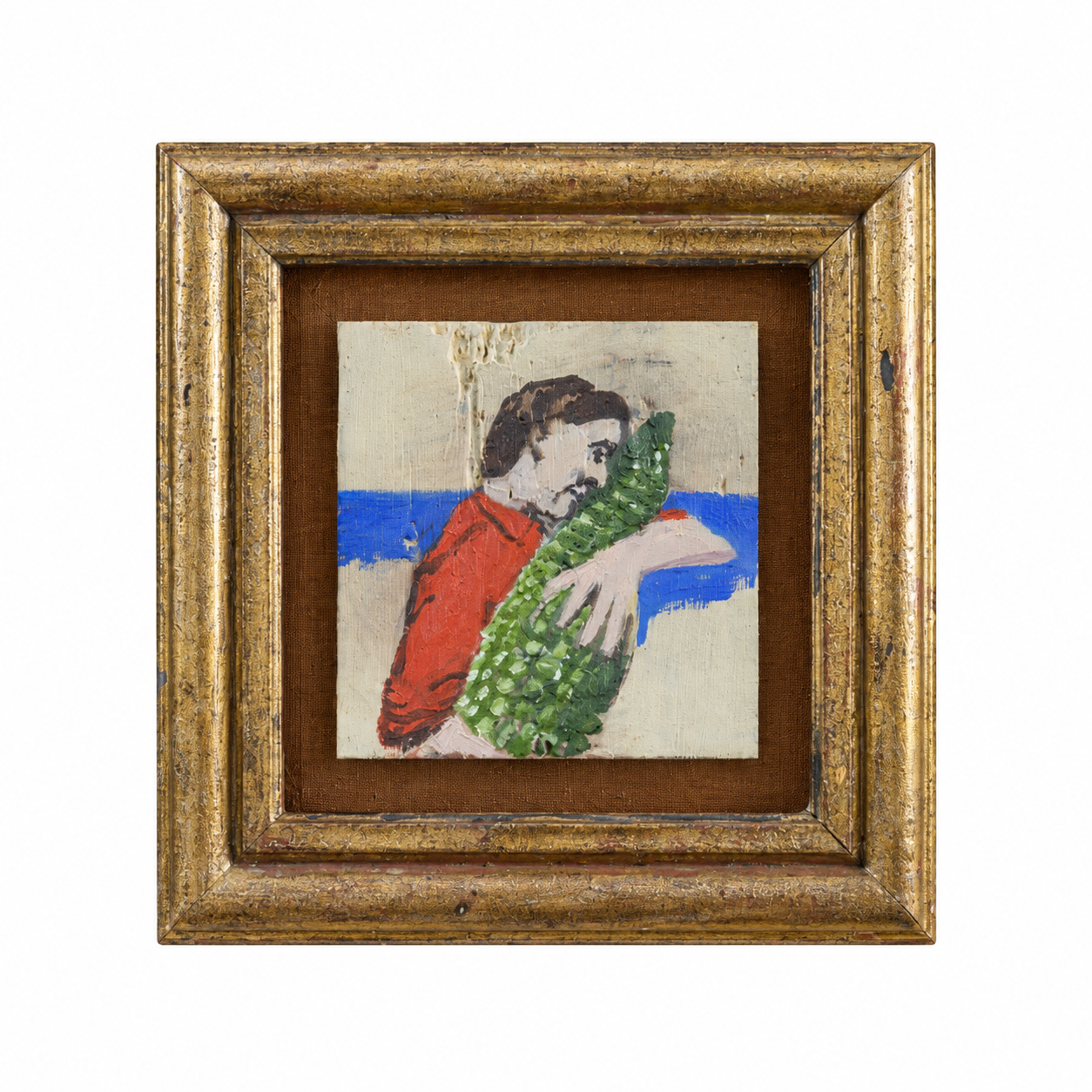
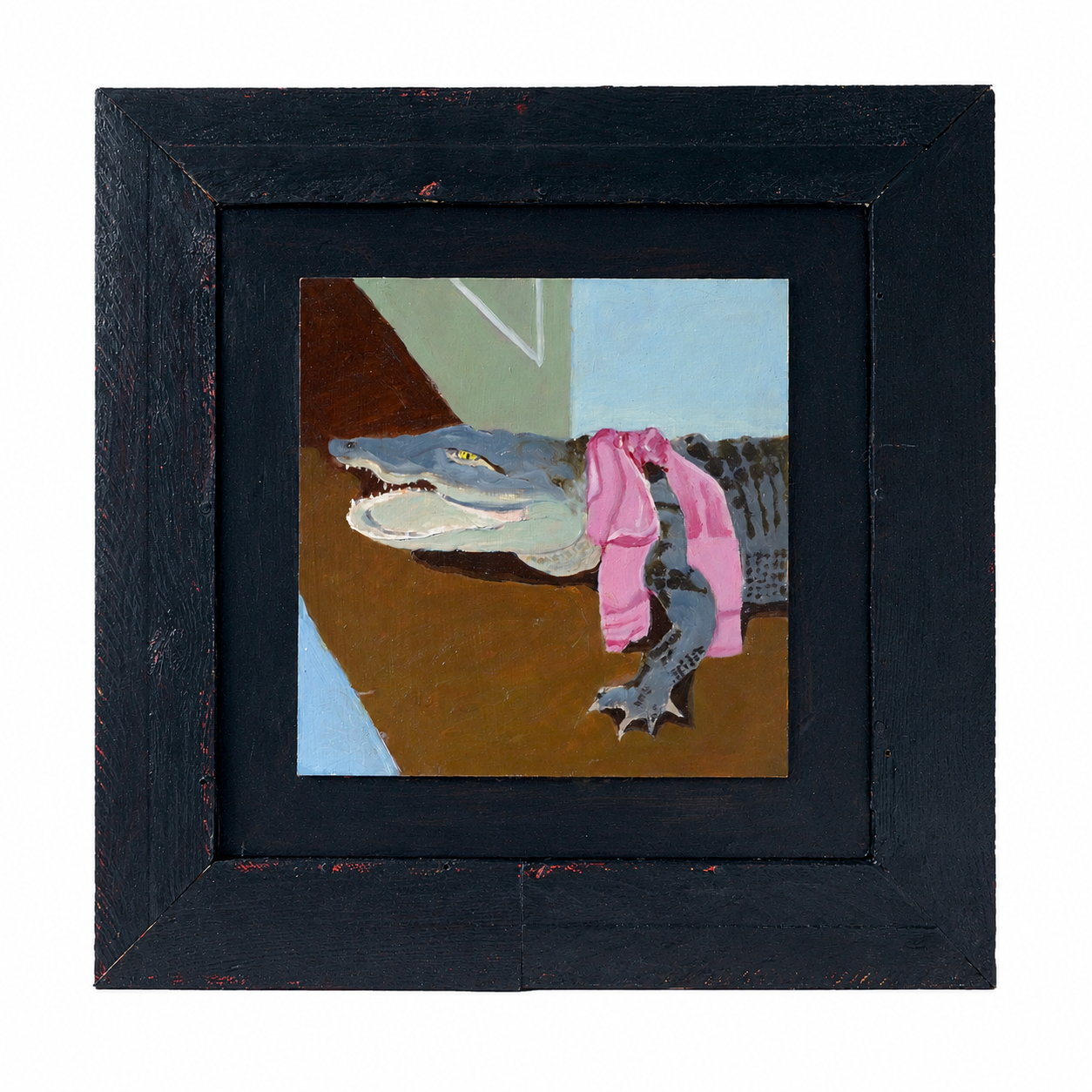
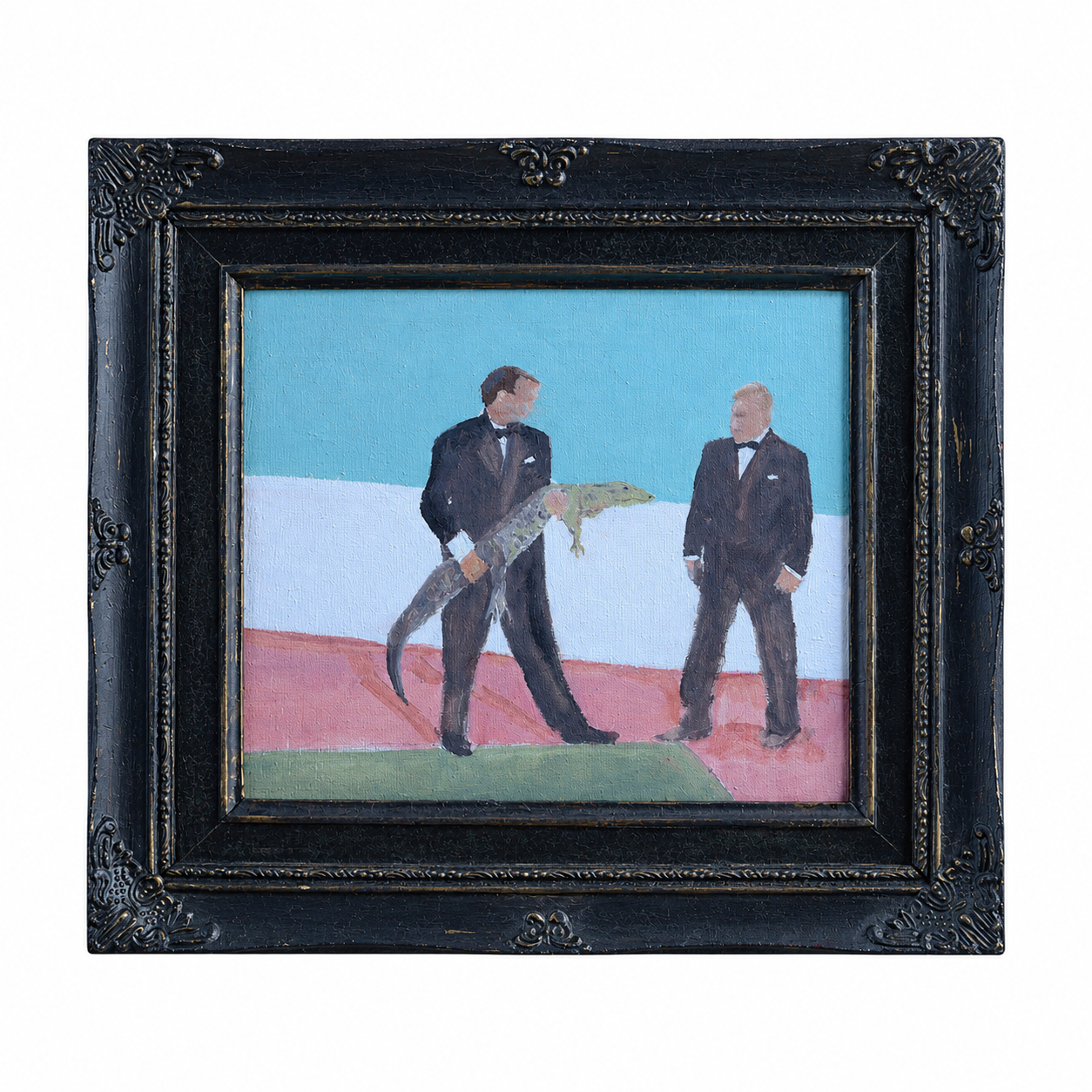
Tim Ridley: Daisy, an exhibition at Projects Twenty Two, Rock, Cornwall, November 2026.
Daisy: the Lizard Alligator.
In 2015, Tim Ridley stumbled across a strange photograph in a magazine: a woman crouching on a bathroom floor, tenderly embracing an alligator, their heads nuzzled together. Drawn to scenes with a ‘wonderful awkwardness to them’, he found it unforgettable. For years, the image lay dormant, waiting to become the springboard for an artistic response. Then, as with many epiphanies, came a conversation in a pub: a friend recalled being taken as a child to see an alligator that lived in a bath in a house in St Keverne, a village on Cornwall’s Lizard Peninsula. When Tim began to investigate, the two stories converged: the alligator from St Keverne was the very one he had encountered in the magazine. The apparent smallness of her life, captured in that bathroom scene, quickly gave way to a story of renown and celebrity – Daisy was a film star.
The woman was Gwen, Daisy’s owner and agent, who had apparently bought her from a ‘temple in Africa for the sum of £2’. For a small fee, curious Cornish folk and visitors from farther afield could meet Daisy, always ready for her close-up and elegantly dressed in a pink bow. She apparently starred in around nineteen films, most famously J. Lee Thompson’s 1955 production An Alligator Named Daisy, alongside Diana Dors and Donald Sinden. On screen, as in life, Daisy was tame and domesticated; therein lay her appeal. A consummate professional, she often travelled from Cornwall to Pinewood or Elstree studios, behaved impeccably and won many hearts.
Tim remembers growing up in Finchley, North London, where a neighbour kept monkeys in a cage inside the house. People would knock at the door to see them, only to find their curiosity met with the animals’ ferocity and a putrid smell. He was fascinated by the monkeys, but also acutely sorry for them, their lives diminished to a performance. The same mingling of curiosity and concern later drew him to the photograph of Daisy. Since moving to Cornwall, it has deepened into a sense of responsibility towards animals and a desire to give voice to those too often overlooked. Living closer to the natural world and swimming in the sea each day have only sharpened that instinct: ‘Cornwall changes someone; it confirms what is important.’
Animals have long held a key place in Tim’s paintings, but his fascination with Daisy has inspired his first fully realised series devoted to a single subject. I first encounter the works in his attic studio, reached by a steep ladder and overlooking Penzance. Around them are stacks of newspaper and magazine clippings, pieces of found wood waiting to become painted surfaces, ornate old frames, art books and Tim’s portrait of Francis Bacon, drawn from a still in a BBC documentary. Bacon’s presence feels apt: like Tim, he drew inspiration from two-dimensional images, gathering them around him and working in the seclusion of a world of his own.
We descend the ladder, Tim with the ease of muscle memory, I rather less deftly, and settle in the lounge, where Daisy has escaped the studio to take her place above the mantelpiece. The painting’s striking simplicity and use of colour recall Édouard Manet, while its immediacy conceals a quiet psychological complexity.
This tension gives the series its emotional charge. Humour and absurdity remain close to the surface, but so do tenderness and unease. Tim avoids sentimentality and accusation, allowing the strange intimacy between Daisy and Gwen, and the spectacle built around it, to remain unresolved. The viewer moves between affection, fascination and discomfort.
As we talk, Tim’s artistic influences come into focus: Peter Doig’s otherworldliness, Marlene Dumas’s human vulnerability, Gerhard Richter’s excavation of memory and Luc Tuymans’s muted palimpsests. Tempered by Tim’s keen sense of humour, these sensibilities quietly underpin the new series, yet its voice is unmistakably his own. Gathered here for the first time, the Daisy paintings sit apart from familiar ideas of art made in Cornwall. They are distinctive and quietly assured, their significance extending far beyond their immediate visual presence. Through one extraordinary animal, Tim brings together questions of captivity, performance, memory and care without forcing them into a simple conclusion. That combination of formal intelligence, emotional restraint and moral attention confirms him as an important painter.
Daisy is curated by Dr Matt Retallick, in association with Daisy Laing.